How Chainle works
Chainle gives you one English word to find for each round. The word is not a password and it is not hidden in a letter grid. It is a connection. Sometimes the connection is a thing that belongs with both clues, sometimes it is a person who does both jobs, and sometimes it is a second meaning that ordinary speech already uses. You type the word, you submit it, and the round closes if the word is a real entry in the common-English list used on this site.
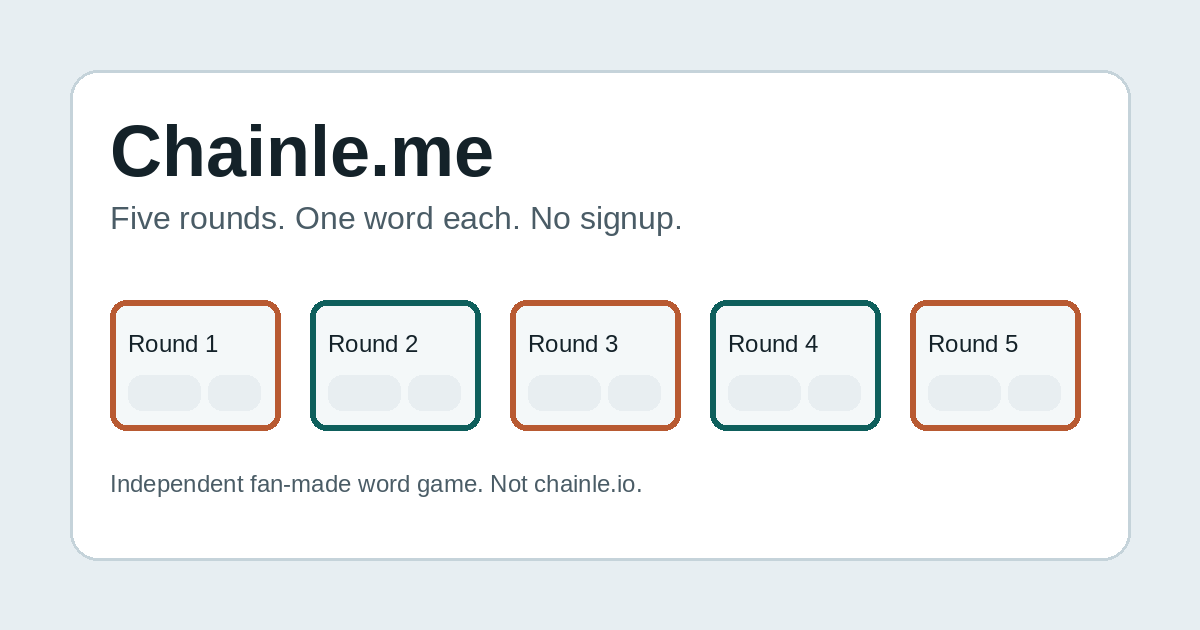
The board above is the whole daily Chainle game. Rounds stay in order. Round 1 is open when you arrive. The later rounds show their clues immediately, and their fields stay quiet until the round before them has a score. There is no clock on the input. Leave the tab and come back, and the same five Chainle rounds are still the Chainle daily puzzle for this UTC date.
Progress in Chainle is kept in this browser under a date key. Finish all five rounds and the day counts toward the streak shown above the clues. The streak only moves when the Chainle daily puzzle dated today, in UTC, is finished for the first time. Refreshing the page restores the rounds you already sent.
Five rounds and three kinds of connection
Play Chainle free by reading the Chainle word connection in front of you. Rounds 1, 2, and 3 are two-word bridges. You see two clues. You want one word that meets both of them in a way you could explain to a friend without a footnote. If your word loves the first clue and only waves at the second, it is probably a partial link. The Chainle scoring rules put those partial links well below 1,000, and a word we never listed at all stays at 40 even when the idea is charming.
A clean two-word bridge often uses a double life that English already gave the word. A tool can serve two crafts. A place-name can be a landscape and an institution. A body word can also be a part of an object. You are not looking for a rhyme, and you are not looking for a word that merely sits in the same paragraph as one clue. Say the clue, say your word, and see whether the phrase is something people actually mean.
Round 4 is the three-word bridge. The same discipline applies, with one more clue that has to be satisfied. Players often find a beautiful bridge for the first pair and then notice the third clue standing apart. That third clue is not decoration. A word that fits two clues and misses the third is not the strongest connection on a three-word round. Slow down and ask which word is doing work for all three, not which word is doing work for the pair you saw first.
Round 5 is a closest connection. There is one clue, and you want a near synonym or the everyday word a careful speaker would accept in its place. This round looks easier, and sometimes it is. It is also where a second meaning of the clue can tempt you. If the clue is a size word, a time word that happens to be spelled the same way is a different sense. The listed alternatives on a closest-connection round are there so a very near synonym can still score high, while a distant cousin does not pretend to be the same idea.
A fresh Chainle word connection is scheduled every day at 00:00 UTC. The three shapes repeat, so the skill transfers. What does not transfer is the answer. Tomorrow's clues are a different set, written and checked on their own. How to play Chainle walks through classroom examples that are not today's puzzle: a piano and a keyboard, a library and a river, snow with a bed and a book, and a single synonym round. Use those when you want the pattern without turning today's board into a lesson that spoils itself.
How scoring works
The Chainle daily puzzle scores each round up to 1,000 points. Five rounds make 5,000. The strongest connection we listed for the round scores 1,000. An accepted alternative scores the number written beside it when the puzzle was checked, always less than 1,000 and always above the unlisted score. A common English word that is not on the list scores 40. That 40 is an honest floor, not a claim that the word has no relationship at all. It means the relationship was not one we wrote down.
We chose a hand-checked list for this version because it is deterministic, it costs nothing to run in your browser, and it can be explained in a sentence. A live vector model would give a smoother curve and would also miss puns, names, and household jokes in a way that is harder to audit. The scoring page says that plainly, including the cases where a dialect word or a second pronunciation will not get the credit a native speaker might expect. Chainle.me does not say that its list is the same system used anywhere else, and it does not say that 1,000 means "the only correct word."
After the fifth round of the Chainle daily puzzle, a share result appears. Copying it puts four lines on your clipboard: the Chainle number and date, the total out of 5,000, five colored blocks, and the home URL. Play Chainle free and the blocks still do not spell clues or guesses.
Why play Chainle daily
The Chainle daily puzzle is a small shared appointment. Everyone who opens Chainle on the same UTC date sees the same five Chainle rounds, and the archive keeps that date playable after the clock moves on. You can chase a Chainle streak, or you can ignore it. Miss a date and the visible streak drops the next time you look. Nothing about that count is sent to a server.
Past Chainle dates live in the Chainle archive. Each revealed day has its own page with the clues, the listed connections, a short explanation of why the link holds, and a board you can play again. Replaying a past date is stored apart from the daily streak. That rule is what stops an archive session from pretending to be today's success. Pages for dates that have not reached 00:00 UTC are not generated, and those puzzles are not included in the public build.
Play Chainle free with no login and no payment. The Chainle word connection is in the HTML before any script runs. The script only asks the server for a score, then remembers it. If one Chainle daily puzzle is not enough, Chainle Unlimited draws another set and does not move the streak.
Chainle FAQ
Is Chainle.me the chainle.io game?
No. Chainle.me is an independent fan-made game with its own puzzle bank — not the official chainle.io product. The sites are not affiliated, endorsed, or connected.
How many rounds are in a daily Chainle puzzle?
Five. Rounds 1 to 3 are two-word bridges, round 4 is a three-word bridge, and round 5 is a closest connection. Each round is worth up to 1,000 points, so a day is worth up to 5,000.
When does the Chainle puzzle change?
A new puzzle is published at 00:00 UTC. Chainle.me does not use Eastern Time. The countdown on the home page is the time left until the next 00:00 UTC.
Do I need an account to play Chainle?
No. There is no signup, no login, and no payment. Progress and streaks stay in this browser. Clearing site data, or switching browsers, clears them. Nothing is synced to another device.
Where can I practice after the daily Chainle puzzle?
Open Chainle Unlimited. Those puzzles are drawn from a separate practice pool. They do not change the daily score or the daily streak.
More answers, including what to do when a round will not budge, sit on the Chainle FAQ. The people and the checking process are described on About Chainle.me. Privacy and terms explain the browser storage and the limits of the scores. If something on the board looks wrong, write to hello@chainle.me and name the date.